
Pulling Back the Curtain: Our 2025 Potato Crop Canopy Penetration Research (Drone vs Ground Rig) with UW-Madison
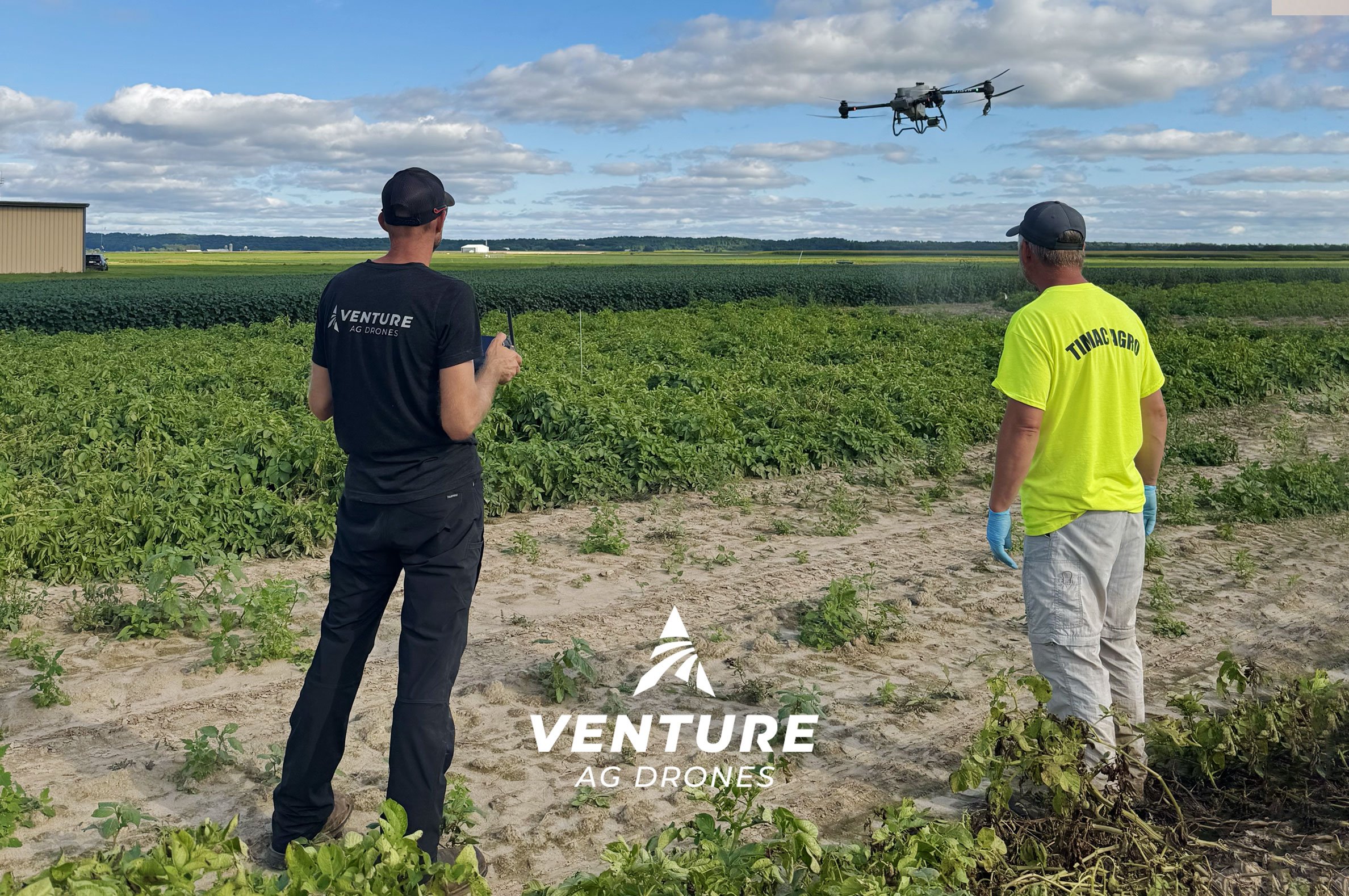
At Venture Ag Drones, we don't believe in guessing when it comes to your yields and your soil. We believe in data which is why we were excited to have the opportunity to participate in this drone vs ground rig trial with UW-Madison.
As precision aerial application continues to grow, we know local growers have a lot of valid questions. Can a drone using 2 to 5 gallons of water per acre really get the same protection as a tractor drenching a field at 20 gallons? How do these applications hold up when the potato canopy closes up late in the summer?
To find out, we teamed up with the experts at the University of Wisconsin-Madison Department of Entomologyand the Langlade Agricultural Research Station right here in Antigo. Throughout the 2025 growing season, we put our DJI Agras T50 to the test side-by-side against a standard ground rig on Atlantic potatoes.
Here we wanted to share the full, unedited findings from this study with the public. Whether you are a local grower looking to protect your soil health or a fellow ag-tech enthusiast, we believe transparency moves our local farming community forward.
Click here to view and download the full, official research PDF
Below, we have broken down the setup, the data, and exactly what these findings mean for the future of your fields in plain, easy-to-read English!
Key Point Highlights
The Goal: To see if a DJI Agras T50 drone spraying at low volumes (2 gpa and 5 gpa) can achieve comparable leaf coverage to a traditional ground rig spraying at high volume (20 gpa).
The Crop: Machine-planted Atlantic potatoes in Antigo, WI.
The Test: Using water-sensitive paper cards placed both on top of the potato leaves and deep inside the plant canopy to measure droplet counts.
The Finding: Because the drone uses much less water (10% to 25% of the ground rig’s volume), it naturally gets lower total coverage on the cards.
The Verdict: The drone did not "underperform." When you scale the math based on how little water the drone used, it performed very close to expectations. The 2 gpa drone actually overperformed its mathematical volume expectation, while the 5 gpa slightly underperformed its volume expectation.
Detailed Overview of the Research
1. Objective
Traditional ground rigs use a lot of water to "drench" a crop (20 gallons per acre). Drones use heavy airflow (prop-wash) to atomize a much smaller amount of water (2 to 5 gallons per acre) into fine droplets. The researchers wanted to see how the coverage and canopy penetration of these two methods stacked up.
2. How the Experiment Was Set Up
Location: Langlade County Airport, Antigo, Wisconsin.
The Crop: Potatoes planted in May 2025.
The Timeline: Tests were run four times throughout the summer (June 25, July 17, July 27, and Aug 21) to capture the plants as they grew from "open" (young/small) to "closed" (thick/bushy).
The Drone Setup (DJI Agras T50): Flown at 23 ft/sec speed.
Flown at 11 ft. elevation above the crop.
Atomizers set to a very coarse droplet size (500 microns).
The Ground Rig Setup (Tractor):
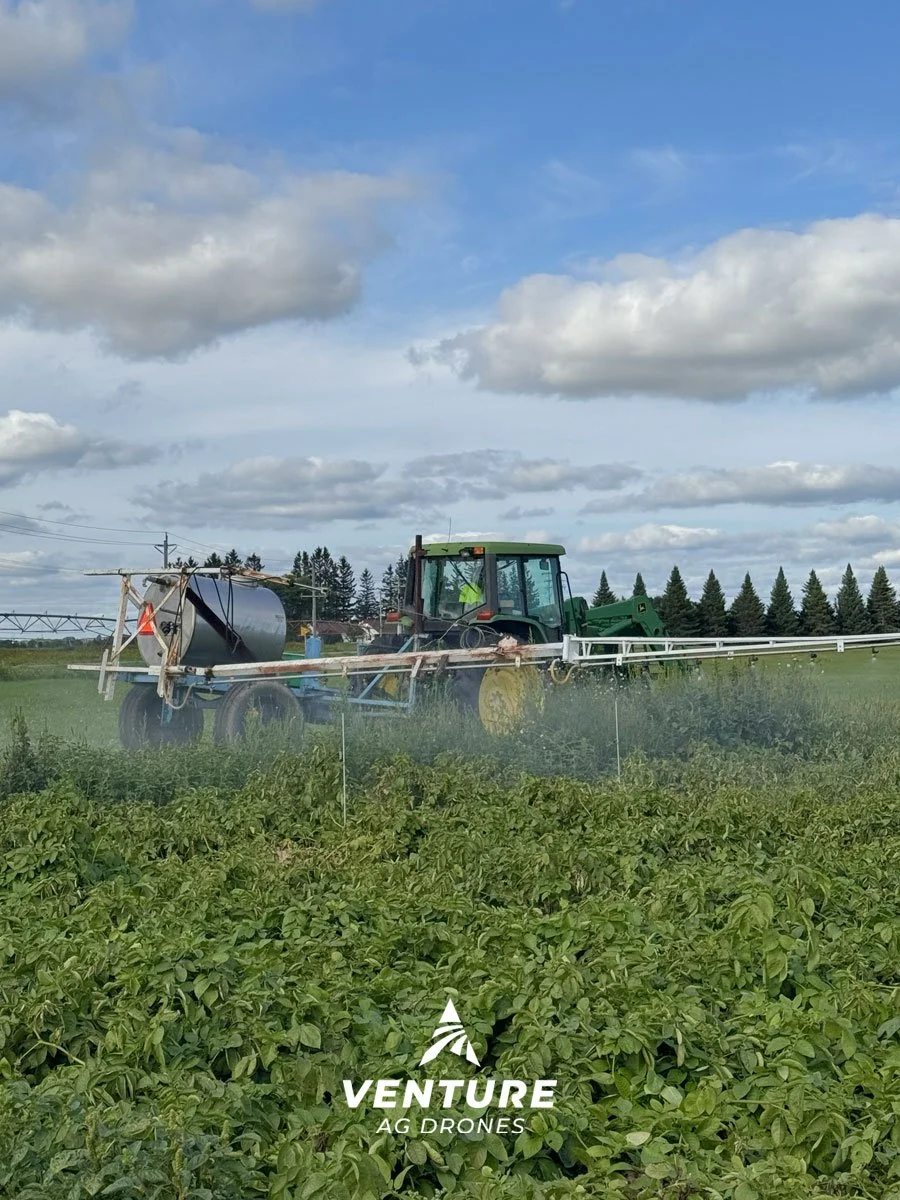
Fitted with wide-angle flat fan nozzles spaced 20 inches apart.
Boom height set to 2 feet above the canopy, driving at 4 mph.
3. How They Measured the Spray
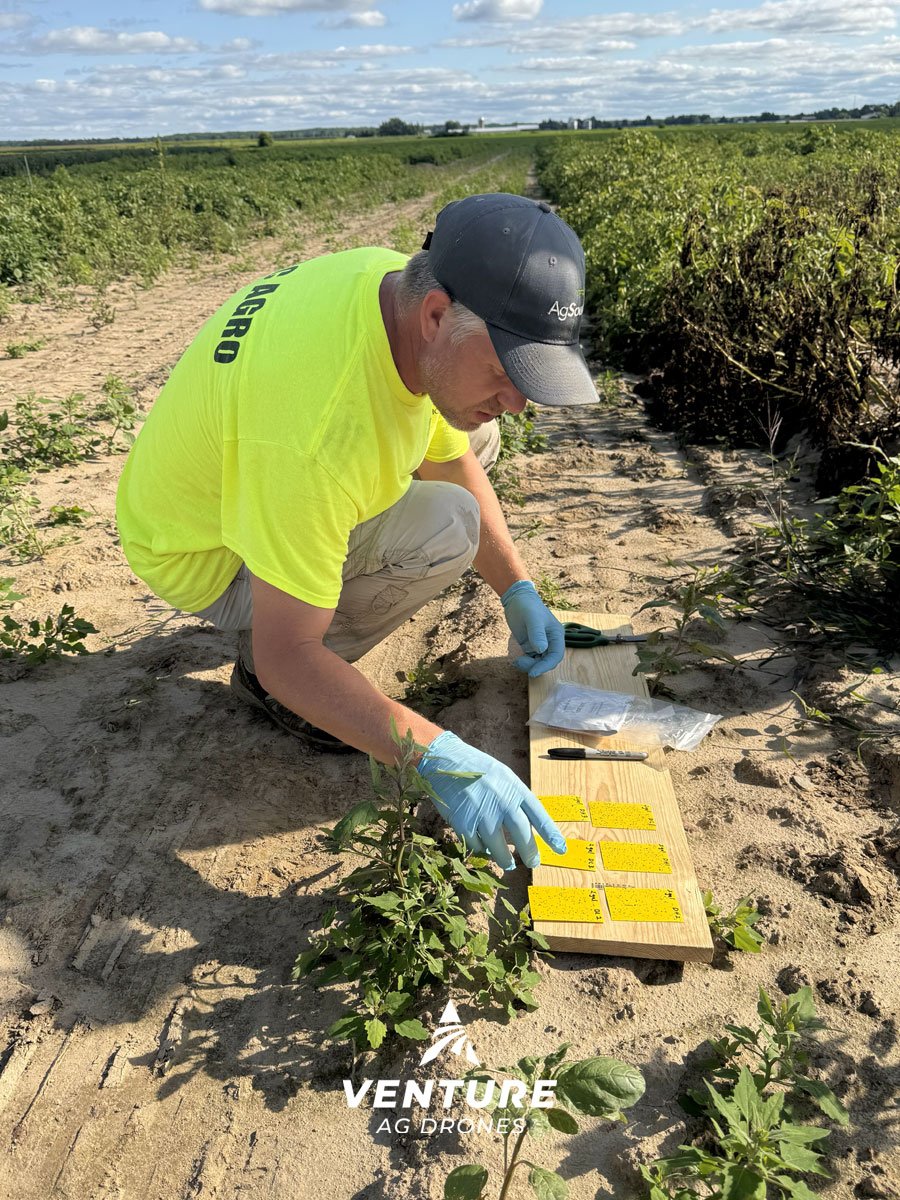
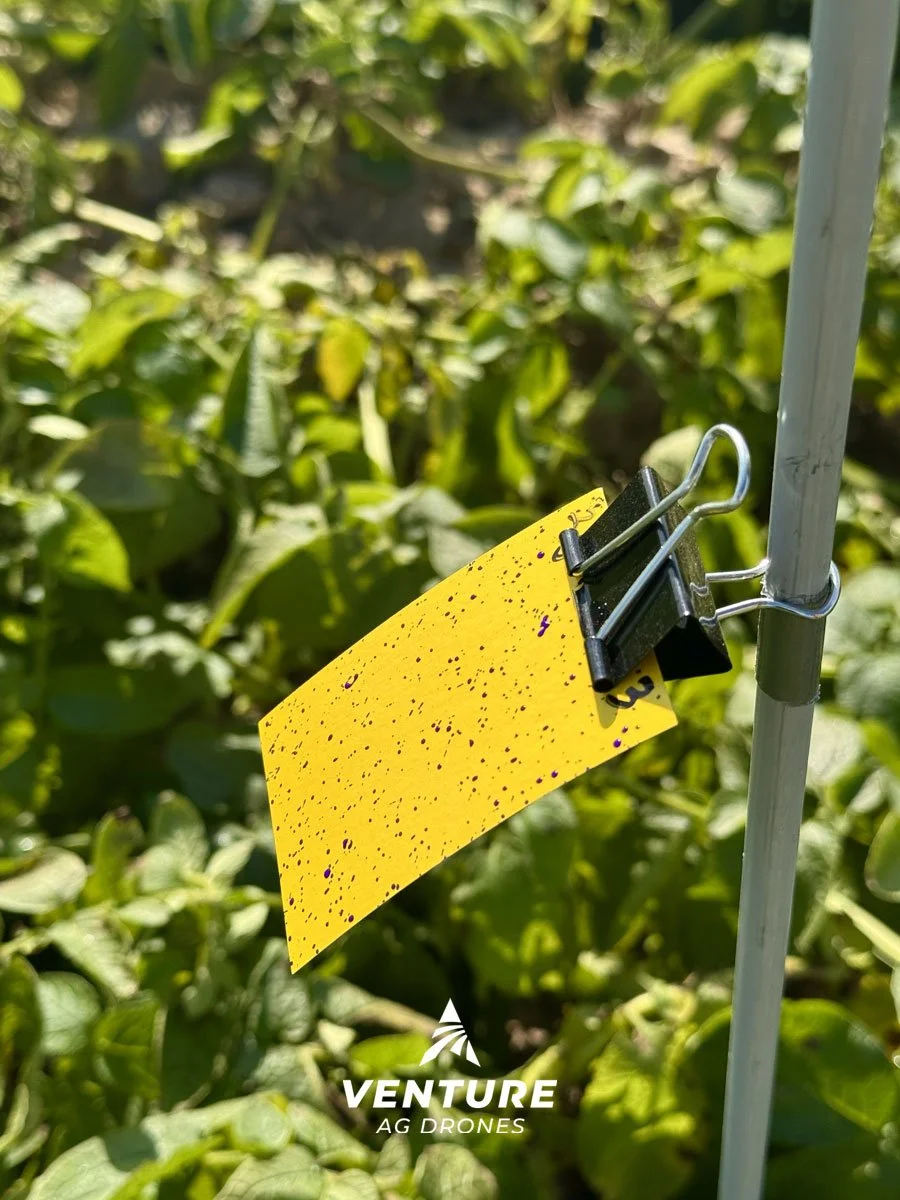
The researchers used Syngenta water-sensitive spray cards. When water hits these yellow cards, they turn blue.
By placing one card on top of the plant and one card buried deep inside the plant canopy (at two-thirds of the plant height), they could see if the spray was just hitting the top of the leaves or if it was actually penetrating down to the stems where diseases often hide. They then used a computer software (ImageJ) to count the blue dots.
4. The Results
The Volume Math: If a ground rig sprays 20 gpa, and a drone sprays 2 gpa, the drone is only using 10% of the water. Naturally, the drone will turn less of the yellow card blue.
Ground Rig Coverage: The ground rig gave a mean card coverage of 18.2%.
Drone (5 gpa) Coverage: Achieved 3.6% coverage. Mathematically, 3.6% is about 20% of the ground rig's coverage. Since it was using 25% of the volume, it slightly underperformed its mathematical weight.
Drone (2 gpa) Coverage: Achieved 2.5% coverage. Mathematically, 2.5% is about 14% of the ground rig's coverage. Since it was only using 10% of the volume, it actually overperformed its mathematical weight.
Canopy Penetration: Penetrating a thick potato canopy is hard for both methods. For both the ground rig and the drone, the cards buried deep inside the plant got less than half the coverage of the cards sitting on top.
The Wind Factor: Low-volume aerial spraying is much more sensitive to wind. High winds (seen on the July 17 test date) significantly disrupted the low-volume drone droplets during this single-pass trial.
What This Means for Ag Drone Operators
The research conclusion wraps up the study by pointing out that these results do not suggest that drone-applied sprays are underperforming per-se. Drone applications rely on ultra-concentrated chemistry and a vortex of air to wrap droplets around leaves, whereas ground rigs rely on spray pressure and massive amounts of water to flood the canopy. The physical mechanics of atomized drone prop-wash and low-volume applications act differently than high-volume drenching, but the drone still scaled very closely to its mathematical volume target.
About Venture Ag Drones
Venture Ag Drones provides custom aerial application in Central Wisconsin including drone spraying and spreading. From row crop to specialty applications, our experience is wide ranging from corn fungicide, potato desiccation, Christmas tree insecticide, greenhouse shade painting, alfalfa new seeding and so much more. Based in Antigo, Wisconsin, we’re here to become your trusted partner in this new age of agriculture technology. Connect with us today using our contact page.
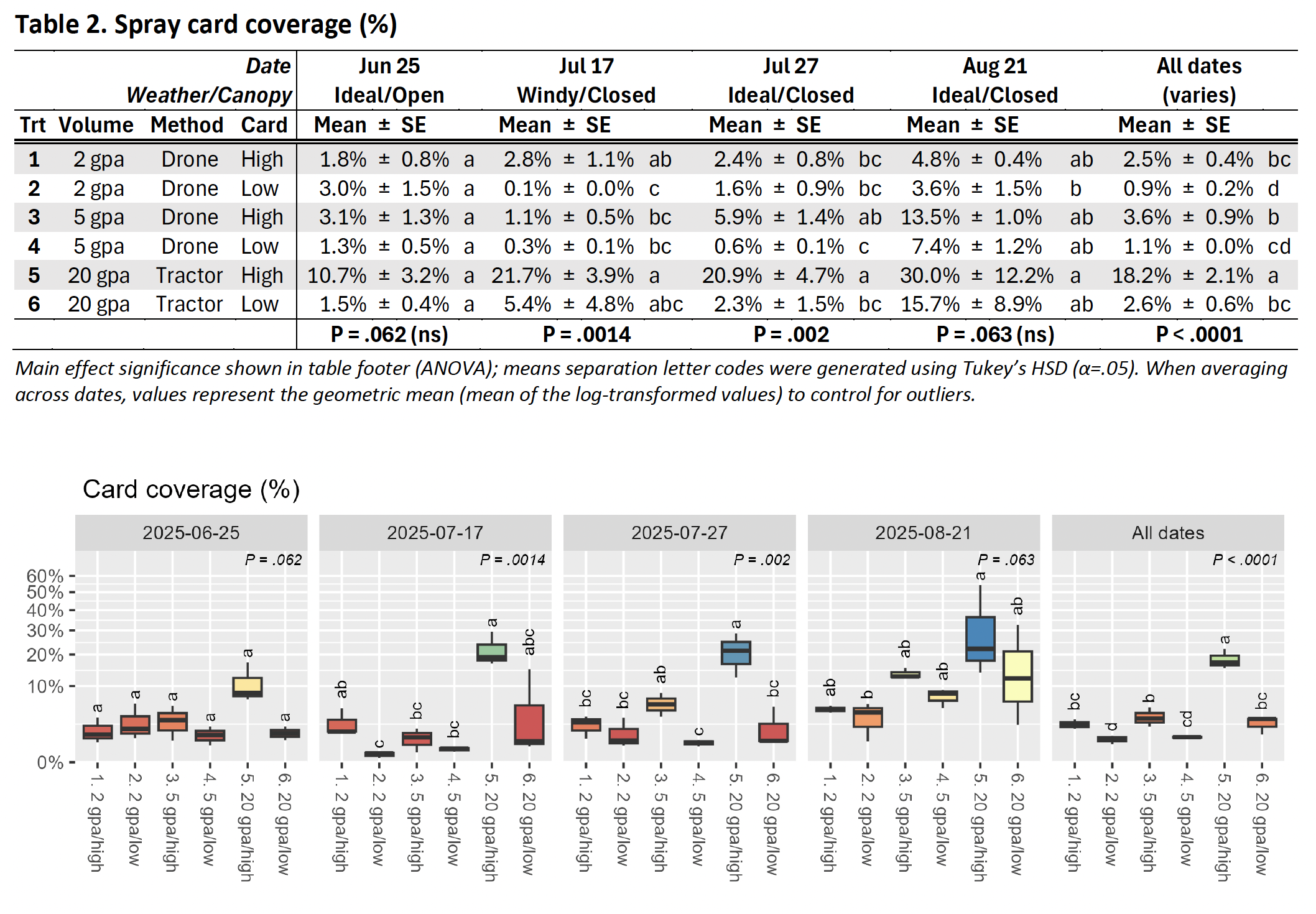
Spray Card Coverage
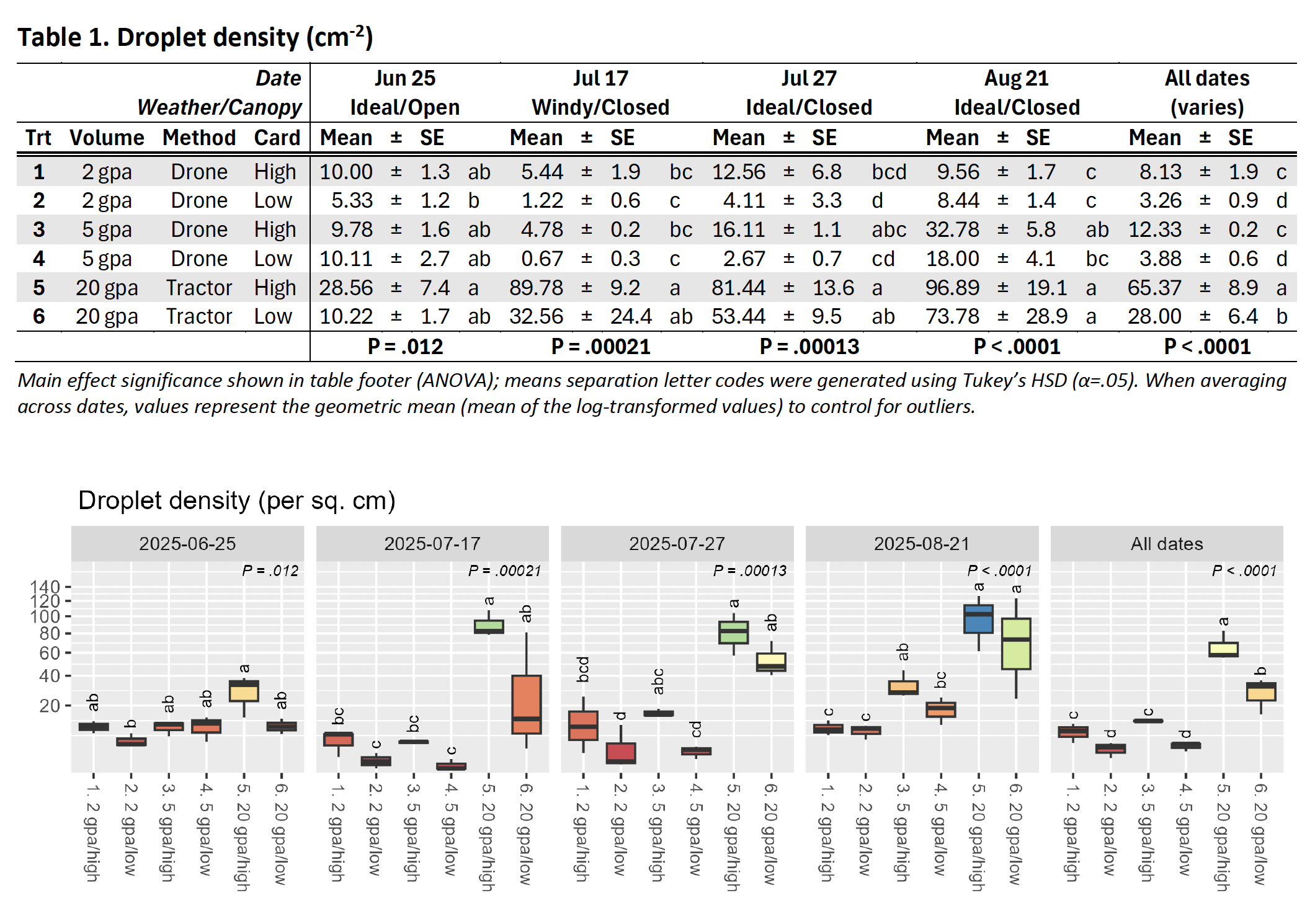
Droplet Density